Issue 005: The Consumer Layer
Three signals that halal finance is no longer a niche. It is a movement.
May 1, 2026
Bismillah.
For most of the past decade, the story of Islamic finance has been told in the language of institutions. Sovereign wealth funds. Central bank frameworks. Sharia boards deliberating over complex structured products. The conversation happened at altitude, between professionals who spoke the jargon, in conference rooms that most Muslims would never enter.
Something has changed.
The builders who emerged from that institutional foundation are now building downward, toward the consumer. Toward the merchant who needs credit to stock her shelves. The university graduate who wants a current account that does not require him to compromise his deen. The working family that wants its savings to grow without feeding systems built on Riba.
This week: a Saudi fintech raising $25 million to make Sharia-compliant credit available to everyday consumers. Pakistan's first Islamic digital bank taking its campaign into shopping centres and onto streets across the country. And a signal from one of Asia's most significant financial institutions that Islamic finance and the global ESG movement are, in fact, the same conversation.
The consumer layer is being built. Let's get into it.
THIS WEEK'S BUILDERS
Three signals. One clear direction.
01 · THE CREDIT LAYER
Madfu: Saudi Arabia's Sharia-Compliant BNPL Raises $25.5 Million
The phrase "buy now, pay later" has become synonymous with a particular kind of financial trap.
In conventional markets, BNPL platforms profit from late fees, deferred interest charges, and the quiet assumption that a meaningful percentage of users will not pay on time. The business model depends, in part, on the financial fragility of its customers. For a Muslim consumer, the calculation is simple: this is not permissible finance.
Madfu is building the alternative.
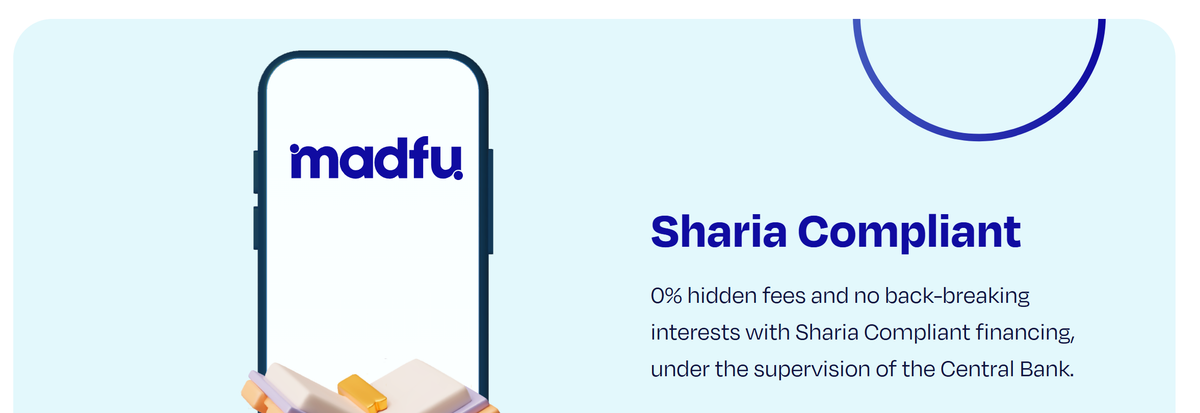
The Saudi fintech has just closed a $25.5 million Pre-Series A round to accelerate its Sharia-compliant BNPL platform across the Kingdom. The name itself carries the intention: Madfu (مدفوع) means "paid" in Arabic. Not borrowed. Not deferred. Paid, on terms that are structured from the start to be transparent, fair, and halal.
Sharia-compliant BNPL works through established Islamic commercial contracts. The most common structure is Murabaha: the platform purchases the goods at cost and sells them to the consumer at a disclosed markup, with payment spread across agreed instalments. There is no interest charged on late payments in the way conventional BNPL operates. The profit is declared upfront. The contract is clear. The transaction is legitimate.
This matters beyond the theological. Saudi Arabia's Vision 2030 agenda is producing a generation of young consumers and entrepreneurs who want financial tools that work for them at speed, on their phones, without a visit to a bank branch. The demand for BNPL is real. The gap that Madfu is filling, between that demand and finance that actually reflects the community's values, is equally real.
Why this matters to you:
Muslim merchants and entrepreneurs face an asymmetry that their competitors do not. Conventional commerce is surrounded by a full ecosystem of credit instruments: inventory financing, supplier credit, consumer instalment plans. The Muslim entrepreneur who refuses these on principle has historically had to operate with more constrained cash flows than those around them.
Madfu is one piece of the infrastructure that closes that gap. For Muslim founders building in the Gulf, and for any Muslim consumer in the region navigating the difference between permissible and prohibited consumer credit, this is a company and a model worth understanding.
The Prophet ﷺ said: "The best of you - or among the best of you - are those who pay off their debts in the best manner."
Ibn Majah 2423
Halal credit is not a lesser product. It is a more honest one.
02 · THE BANKING LAYER
Raqami Islamic Digital Bank: Banking the Muslim Masses in Pakistan
Pakistan is home to over 230 million people. More than 97 percent of them are Muslim. And for most of the country's history, the banking system they were born into was built on interest.
Not because Pakistani Muslims did not want an alternative. But because the alternative did not exist at the scale, accessibility, or digital convenience that modern life demands.
Raqami is changing that.
Pakistan's first dedicated Islamic digital bank has launched a nationwide activation campaign, taking its message into shopping centres, streets, and communities across the country. The campaign is not a press release or a LinkedIn announcement. It is a physical presence, a conversation at ground level, an invitation to a community that has been told for too long that ethical banking means inconvenient banking.
"Raqami" (رقمي) means "digital" in Arabic. The name is a declaration of intent: this is Islamic banking redesigned for the smartphone era. Current accounts, savings, transfers, and financial management on a platform built from the principles up, not conventional banking with a Sharia certificate attached at the end.
The distinction matters. Much of what passes for "Islamic banking" in the conventional market is retrofitted: interest-based products restructured to satisfy minimum compliance requirements. What Raqami is attempting is different. A neobank architecture, built on Islamic commercial structures from the start, designed for a population that should never have had to choose between their faith and their financial infrastructure.
Why this matters to you:
Pakistan is the world's fifth-largest country by population and one of the most underserved markets in Islamic finance. It also has one of the fastest-growing smartphone penetration rates in the region. When an Islamic digital bank begins activating at street level, it is not a soft launch. It is a signal that the mass-market moment for Islamic fintech has arrived in a country of 230 million people.
For Muslim founders and investors outside Pakistan, the lesson is structural. Raqami's growth, when it comes, will validate a model: that Islamic-first design, not Islamic adaptation, is what the next generation of Muslim consumers actually wants. Every market with a significant Muslim consumer base, from Indonesia to Nigeria to the United Kingdom, is watching this experiment.
The Prophet ﷺ said: "Allah has permitted trade and forbidden Riba."
Quran 2:275
A bank built on that verse, for a country of 230 million, is not a small thing.
03 · THE CAPITAL LAYER
Islamic Finance Meets ESG: The Signal That Changes Everything
Every few years, a mainstream institution says something that Muslims have understood for fourteen centuries, and the financial press treats it as a discovery.
This week, that institution was Maybank, one of Southeast Asia's largest and most influential financial groups, and the statement came from its first-ever Chief Sustainability Officer, in an interview published by Fortune.
The message: Islamic finance aligns naturally with ESG.
This is not a controversial claim. It is an obvious one. Islamic commercial law has always prohibited investment in industries that cause harm: weapons, alcohol, gambling, exploitation. It has always emphasised contracts built on transparency and mutual benefit. It has always linked the legitimacy of profit to the real value created by the underlying transaction. These are not fringe positions. They are the foundational architecture of halal commerce, established fourteen centuries before the term "Environmental, Social, and Governance" was coined in a United Nations report in 2004.
But the significance of Maybank's public framing is not theological. It is commercial.
ESG is now a multi-trillion-dollar asset category. Institutional capital from pension funds, sovereign wealth funds, and asset managers across Europe, North America, and Asia is actively searching for investments that meet ESG criteria. And a growing portion of that capital is beginning to recognise that the Islamic finance universe, screened by Sharia standards, maps almost precisely onto what ESG frameworks are trying to create.
Why this matters to you:
If you are a Muslim founder raising capital, or a Muslim investor managing a portfolio, this alignment opens a door.
Sharia-compliant businesses are, by definition, ESG-screened. They do not invest in weapons. They do not profit from alcohol or gambling. They do not build financial models on predatory lending. The ethical vetting that Muslim entrepreneurs apply as a matter of faith is the same vetting that a growing class of institutional investors applies as a matter of mandate.
Maybank's public articulation of this connection is a signal to the market. It says: Islamic finance is not a niche product for a niche community. It is a framework that produces outcomes the mainstream world of ethical investment is actively trying to create. The Muslim builder who understands this, and can articulate her business in both languages, is positioned to access capital that was never previously available to her.
The global pool of ESG assets under management is estimated at over $30 trillion. The global pool of Sharia-compliant assets is estimated at $6 trillion and growing. These are not two separate conversations. They are one conversation, and Muslim entrepreneurs are uniquely positioned to speak it fluently.
The Quran commands us to be witnesses to justice, even against ourselves.
Adapted from Quran 4:135
That commitment to justice is not a constraint on commerce. It is the credential.
THE BIGGER PICTURE
Three stories. One direction.
Issue 004 of this newsletter was about infrastructure: the payment rails, contract systems, and banking architecture being built beneath the Muslim digital economy. This week's issue is about what happens when that infrastructure starts serving people.
Madfu puts Sharia-compliant credit in the hands of consumers who have never had it. Raqami puts Islamic banking on the smartphone of a Pakistani family who assumed their options were limited. And the ESG alignment being articulated by institutions like Maybank opens a pathway for Muslim-led businesses to access a class of capital that operates on the same ethical logic they already live by.
The question for this community has never been whether we have the values to build something better. It has always been whether we have the infrastructure, the capital, and the tools to translate those values into systems that reach everyone.
This week's builders are answering that question.
The consumer layer is under construction. It will not look like the conventional economy. It will be more honest, more transparent, and more aligned with the principles that 1.8 billion people have always held. That is not a compromise. That is an upgrade.
UNTIL NEXT WEEK
Are you building a product or service that reaches Muslim consumers directly? Are you raising capital and navigating the halal credentials that matter to ESG-aligned investors?
Have thoughts on this issue or an idea for the ecosystem? Reach out directly at founder@ummahnext.com.
This newsletter grows because of you, not algorithms. Share it with one person in your network who is building something halal, and let's keep expanding this community together.
Jazakallahu Khayran. Until next week.
The Ummah Next Team